


Barista’s Note
Food is no longer just a matter of nourishment. It has become a reflection of global inequality, systemic fragility, and industrial design. While hunger persists in many regions, the broader crisis is defined not by scarcity but by uneven distribution, declining nutritional quality, and growing dependence on ultra-processed, commercially engineered diets.
In this issue, we highlight the factors responsible for reshaping food systems and nutritional value. We examine the convergence of Big Food and Big Pharma, the rise of synthetic food alternatives, and the growing divide between those who eat to survive and those who eat to thrive.
The Deep Drip
Hunger is the best sauce — Miguel de Cervantes Saavedra
Food security is one of the defining challenges of the 21st century. An estimated 319 million people are currently facing acute hunger across 67 countries, and that number continues to rise as multiple global systems come under strain. The current food crisis (Figure 1) is multifaceted and reflects a complex convergence of ecological degradation, economic disparity, geopolitical instability, and the rapid transformation of how food is produced and consumed. The global food crisis cannot be fully understood without recognising the lived realities of food insecurity across different regions. The Integrated Food Security Phase Classification (IPC) outlines five levels of acute food insecurity (Figure 2), from Phase 1 (Minimal/None) to Phase 5 (Catastrophe/Famine). As of 2024, millions of people remain trapped in Phases 3 to 5, where urgent action is needed to prevent malnutrition, excess mortality, and the total collapse of livelihoods. Although the world produces enough food to feed its population, millions remain undernourished while ultra-processed, low-nutrient foods dominate markets everywhere. Furthermore, the system is increasingly shaped by climate shocks, fragile supply chains, unequal access, and profit-driven models that prioritise volume over value. Food is no longer just a matter of nourishment but a global competition where health, longevity, and survival depend on where you live, how much you earn, and what the system makes available to you.


Food quality has experienced an alarming decline over the last sixty years, marked by a significant reduction in essential minerals and nutraceutical compounds found in fruits, vegetables, and staple crops. This nutritional erosion has occurred alongside an increase in chronic health conditions, prompting deeper scrutiny into the systems shaping global diets. At the centre of this decline is the long-standing romance between Big Pharma and Big Food. Although both industries position themselves as champions of human well-being, their shared interests have produced a model that prioritises profit over public health. Their historical and strategic alignment has contributed to the normalisation of low-quality food options while generating enormous revenue streams from treating the very diseases these diets help create. This relationship dates back to the early 1950s, when antibiotics, initially developed for human medicine, became a foundation of industrial agriculture. Today, this practice is widely recognised as a key driver of antibiotic resistance, a global health threat that continues to escalate.
The Economics of Scarcity
The cost of basic food items has increased dramatically across the world, often rising faster than wages and general inflation. While global markets continue to focus on maximising food supply, affordability has quietly become one of the most significant barriers to access. In many regions, the price of staples like rice, maize, and wheat has somewhat doubled over the past decade. This growing gap is not only the result of supply disruptions, but also a reflection of how food has become a financial asset in a system that rewards speculation over sustainability.
Rising income inequality has intensified the divide. For low-income households and marginalised communities, food choices are often limited to ultra-processed, calorie-dense options that are inexpensive but nutritionally poor. These foods dominate global shelves and are marketed aggressively, yet they contribute heavily to chronic disease and long-term health risks. In contrast, wealthier populations have access to diverse diets, organic produce, and nutrient-rich alternatives. The gap between eating to survive and eating to thrive is growing, and it often reflects structural inequality more than individual choice.
This imbalance has fueled the growth of a premium health economy where wellness products, curated diets, and functional foods have become status symbols. Access to good nutrition is no longer just about location or education but increasingly shaped by class. As a result, some communities struggle with undernourishment and food insecurity, while others navigate the consequences of overconsumption and lifestyle diseases. In many cases, both realities coexist within the same cities, divided by income, infrastructure, and access.
The Industrialisation of the Palate
Innovation in food is moving quickly, but it is not always moving in the direction of health.
The modern food crisis cannot be understood without examining the role of Big Pharma and its entanglement with food systems. As nutrition has declined, pharmaceutical interventions have filled the gap, not by improving food quality, but by managing the diseases it creates. The result is a system where ultra-processed diets fuel chronic conditions such as obesity, hypertension, and diabetes, which in turn drive the growth of the pharmaceutical industry. This is not a coincidence. It is a cycle of dependence that benefits industry while eroding long-term health resilience.
At the same time, food itself is being reinvented. Gene-edited crops, synthetic proteins, and lab-grown meat are no longer niche technologies. They are actively shaping the future of agriculture and nutrition. These innovations are often framed as sustainable solutions to global hunger, but many are designed for scalability and market performance rather than nutritional value. What began as an attempt to feed the world is increasingly defined by what is profitable to produce at scale.
In parallel, the branding of lab food as modern, ethical, or environmentally friendly has often obscured its nutritional shortcomings. This shift has allowed convenience and novelty to outpace substance. The health consequences are already visible. Food deserts persist across both urban and rural landscapes, while metabolic diseases continue to rise globally.
Climate, Collapse, and the Illusion of Sustainability
The global food system is increasingly vulnerable to the effects of climate change. Erratic weather patterns, prolonged droughts, and water scarcity are disrupting crop cycles, reducing yields, and destabilising already fragile agricultural regions. As climate volatility intensifies, food production is becoming less predictable and more uneven, especially in areas that are least equipped to adapt.
These ecological stressors are straining the interconnected web of global food supply chains. From fertiliser shortages and soil degradation to disrupted shipping routes and crop disease outbreaks, the system is showing clear signs of fatigue. Countries that once relied on food imports are facing new vulnerabilities, while exporters are tightening controls to protect the domestic supply. The result is a world where food access is no longer governed by abundance, but by climate resilience and infrastructure.
In this context, the popular language of “sustainability” often falls short. Many solutions remain surface-level, focused on packaging, marketing, or carbon offsets rather than fundamental transformation. True resilience goes beyond optics. It involves diversifying crop systems, restoring soil health, securing water sources, and reshaping global food flows around equity rather than efficiency. Without these shifts, the promise of sustainability risks becoming a mere branding exercise.
Espresso Shots
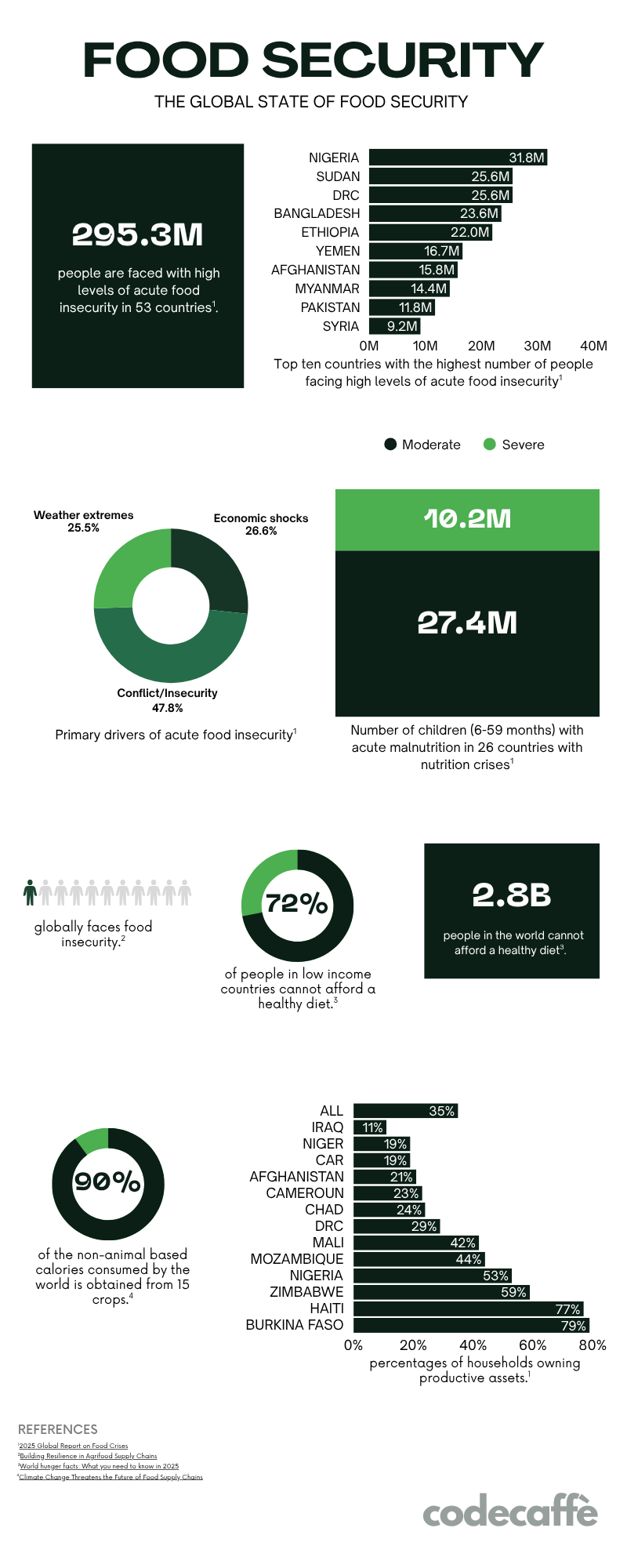
The infographic below provides a summary of the global state of food security.
Crème de la Crème
This segment showcases standout companies and startups solving problems related to food sustainability.
Led by Damilare O. Odumosu, M.Eng. | Rillwan Shokunbi
Empowering farmers with cutting-edge AI and data driven solutions for efficiency and sustainability.
Led by Saar Safra
Beewise is a precision beekeeping company using technology to protect pollinators and secure global food systems.
Led by Robert Terry
SeafoodAI is revolutionising seafood sourcing with advanced technology, enhancing sustainability and profitability through real-time data insights and instant verification.
Led by David Blyth | Bharath Sudarsan | Nicholas Clermont, P. Eng.
Empowering dairy farmers with better insights into the health and productivity of their herds.
Led by Daniel McCann
Accelerating artificial intelligence-based farming practices that create healthier, happier, and more profitable farms.
Led by Per Aage Lysaa
Providing vertical farming solutions at scale.
Grind Articles
Take a deep dive at research articles related to the theme of this issue.
- The future of the future foods: understandings from the past towards SDG-2
- An Alarming Decline in the Nutritional Quality of Foods: The Biggest Challenge for Future Generations’ Health
The Last Sip
These articles and blogs offer additional context and perspectives on the ideas we explored.
- World hunger facts: What you need to know in 2025
- 2025 Global Report on Food Crises
- The Broken Plate 2025: The State of the Nation’s Food System
- Synthetic Chemicals in Food: A Hidden Public Health Risk
- Lab-grown food could be sold in UK within two years
- Australia’s first lab-grown meat will be on menus within weeks
- Climate Change Impacts on Agriculture and Food Supply
- From Farm to Table: The Economic Impact of Climate Change on the Food Chain
- Climate Change Threatens the Future of Food Supply Chains
Beyond the Brew
Across the globe, food systems are being reengineered in response to crisis. Climate shocks, market speculation, and technological intervention are reshaping what is grown, how it is distributed, and who has access. But not all innovation is created equal. Some solutions reinforce the very inequalities they claim to solve. Others turn hunger into a business model.
Responsible food innovation must prioritise people, not just profit. That means asking hard questions about ownership, access, and long-term consequences. The path forward requires more than new tools. It demands intentional design, public accountability, and a commitment to food as a fundamental human right.
If your work intersects with public health, food justice, policy, or sustainable innovation, let’s connect. I am open to collaboration, editorial partnerships, and consulting engagements focused on equitable systems and critical storytelling.
If you’ve made it this far and you’re hungry for more…
Gain early access to AI in Healthcare — Innovations, Opportunities & Challenges, the first release in the Research Intelligence series. This premium, research-backed document examines the tools, regulations, adoption frameworks, and global disparities that are shaping the future of AI in clinical environments.
📘 What’s inside:
- 60+ pages of expertly curated, visually engaging content
- Detailed benchmarking of AI tools and models used in clinical settings
- Global case studies from North America, Africa, Asia, and Europe
- Practical frameworks for evaluating and adopting AI in hospitals
- Policy and governance analysis of Health Canada, FDA, and the EU AI Act
- AI adoption checklist for healthcare leaders