


Barista’s Note
AI is helping solve some of the world’s most pressing water issues. Governments and startups are deploying it to manage flood risks, optimise irrigation, and monitor water quality at scale. Although AI is solving real problems in water conservation, from detecting leaks to forecasting droughts, very little attention is paid to how much water it requires to function. Beneath the breakthroughs, data centres powering these systems consume millions of litres of water for cooling.
This newsletter highlights the interplay between our planet’s most vital resource and humanity’s most powerful technology. As we continue to march aggressively through the fast-evolving world of AI, much of the emphasis is focused on its speed, scale, and elegance. But it is worthwhile to pause and ask: What’s the true cost of intelligence?
The Deep Drip
Water No Get Enemy (Water has no enemy)-Fela Kuti
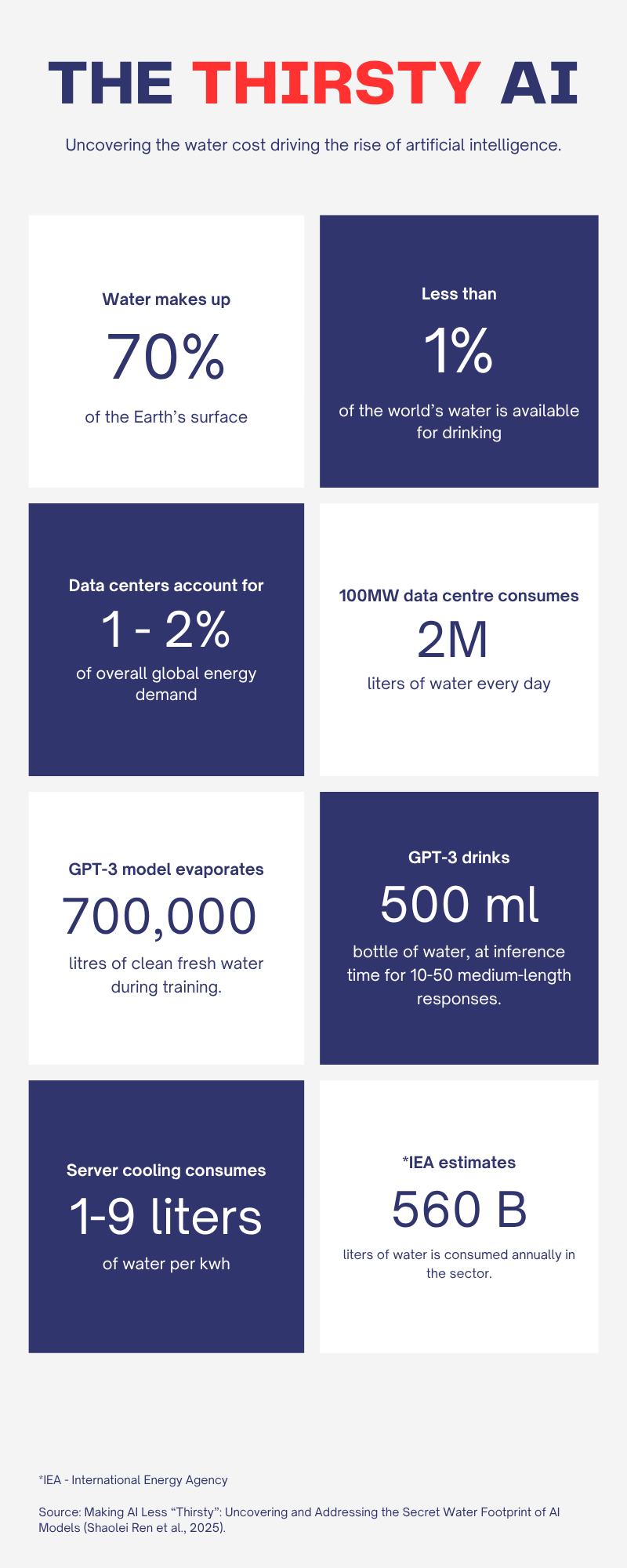
Water is our planet’s most essential resource, covering approximately 70% of the Earth’s surface. Despite its abundance, only a tiny fraction of this water is usable. Just 3% of the world’s water is freshwater, and nearly two-thirds is locked away in glaciers, ice caps, or otherwise inaccessible for human use, leaving less than 1% of all water on Earth available for drinking, agriculture, and sanitation. This limited supply is unevenly distributed and increasingly stressed by pollution, population growth, and climate change. Today, it’s estimated that 1.1 billion people worldwide lack access to clean, safe drinking water, and nearly 2.7 billion people face water scarcity for at least one month every year. These shortages affect not just households, but also agriculture, healthcare, and industry.
As global demand rises and climate extremes intensify, water security is emerging as one of the defining challenges of the 21st century, requiring urgent innovation, collaboration, and more efficient resource management. Researchers and industry experts are leveraging state-of-the-art artificial intelligence (AI) algorithms to accelerate research & development in water security and conservation towards providing safe, affordable and clean water for all. The applications of AI in water security and conservation include smart irrigation, leakage detection, flood prediction, quality modelling & monitoring, treatment plant optimisation and resource planning & allocation.
Energy Consumption by Data Centres
Generative AI service providers rely on energy-intensive data centres for their operations. In the US, this energy is supplied by thermoelectric power plants. According to a Washington Post report in collaboration with researchers at the University of California, a 100-word email requires 0.14kWh of electricity or enough energy to power 14 LED lamps for an hour. Data centres account for 1-2% of global energy demand, rivalling what the airline industry consumes. Some sources estimate that global AI could consume 85-134 TWh of electricity in 2027. A more aggressive projection by a recent US data centre energy report predicts that electricity consumption by AI servers in the US alone will surpass 150-300 TWh in 2028.
Measuring the Impact of AI on Water Resources
In one study, the utilisation of water by AI was categorised into three scopes; Scope-I involves water utilisation in server-level cooling at data centres. Most server cooling infrastructure depends on fresh water for heat dissipation, which is estimated to consume between 1 and 9 litres per kWh in some instances. 80% of the water used in the cooling process is evaporated, while the remaining 20% is sent to a wastewater facility. Scope-II water utilisation in data centres is linked to electricity utilisation, as most of the data centres are powered by thermoelectric plants with an estimated 43.8L/kWh in water withdrawal. Scope-III utilisation highlights water consumption in the AI chip and server manufacturing industries. Apple’s supply chain accounts for 99% of the water utilisation in its water footprint.
The International Energy Agency (IEA) revealed that an average 100 MW data centre in the US consumes around 2 million litres of water daily. Globally, the IEA report estimates that the sector consumes more than 560 billion litres of water annually, with projections as high as 1,200 billion litres by 2030. Training GPT-3 language model in Microsoft’s state-of-the-art US data centres can directly evaporate 700,000 litres of clean freshwater. At inference, GPT-3 needs to drink a 500ml bottle of water for roughly 10-50 medium-length responses, depending on when and where it is deployed. More worrying is that when situating data centres, water has become one of the last considerations for industry operators, with the cost of real estate and power as the main drivers. In participating in the AI race, arid regions like Saudi Arabia and the UAE, suffering from water scarcity due to their desert climate, have also begun investing in data centre developments.
Sustainable & Environmentally Friendly AI for the Future
Fossil fuels revolutionised the world but left behind a trail of environmental challenges. Similarly, artificial intelligence is reshaping our future while raising urgent questions about sustainability. Like oil companies, tech giants are opaque about the environmental impacts of their operations regarding data reporting about AI’s water consumption. Industry players need to promote better transparency in this sector to facilitate research and development in designing more environmentally friendly and water-efficient cooling systems for data centres. Since AI data centres already generate enormous amounts of heat as waste products, they can be repurposed into thermal generating plants for diverse purposes. Heat pumps can feed the generated waste heat into direct heating networks to provide hot water in nearby communities. The waste heat can also drive low-temperature desalination plants or other industries requiring warm water or controlled heat.
Underwater data centres appear like a long-lasting, feasible solution to the sustainability problem. Industry leader Microsoft has already explored this concept through Project Natick, which has submerged 855 servers for 25 months and 8 days near Scotland’s Orkney Islands. Although the project was reported to have yielded very positive results compared to land-based data centres, it has been discontinued. China is leading in this direction with Highlander, its 1300-tonne commercial underwater data centre near Hainan Island, which is 35m below sea level. Earlier this year, the facility was upgraded with 400 high-performance servers capable of handling 7,000 DeepSeek queries per second.
Espresso Shots
The infographic below provides summary statistics about water consumption by data centres.
Crème de la Crème
This segment gives a shoutout to some startup companies pushing the boundaries in clean and sustainable tech for the future of our planet.
NPHarvest
By Juho Uzkurt Kaljunen | Sara Ikonen
Providing technology solutions that recover nitrogen and phosphorus from nutrient-rich water streams and transform them into safe and reusable products for agriculture and industry.
XAtoms
By Diana Virgovicova | Kerem Topalismailoglu | Shirley Zhong
Leveraging artificial intelligence and quantum chemistry for photocatalyst discovery. Their technology aims to improve accessibility to safe, affordable and clean water by harnessing visible light (unlike traditional ultraviolet light-based methods) to break down water contaminants.
Newdigit
By Derick Nwasor | Joy Egbe
Developing next-generation technology leveraging PEM (proton-exchange membrane) fuel cells to generate electricity from wastewater for mission-critical industries in healthcare and agriculture. Their flagship solution, Just Add Water, is a single-unit compact product that recycles dirty water into electricity, medical-grade oxygen and clean drinking water.
Ocean Oasis
By Thomas B. Johannessen | Sebastián Feimblatt
Harnessing wave energy to power industrial-scale, zero-emissions offshore seawater desalination plants, their pilot DesaLIFE project aims to provide small fleets of wave-powered desalination buoys that provide 2000 m3/day of carbon-neutral desalinated water, serving the needs of about 15,000 residents along the northern coast of Gran Canaria in Spain’s Canary Islands.
Biota
Developing molecular diagnostic technology for waste-water treatment plants to track PFAS (per- and polyfluoroalkyl substances) in sewer sheds with real-time actionable data. Their first point-of-care diagnostic technology provides wastewater treatment facilities with rapid, laboratory-quality test results.
AquaAffirm
Developing innovative low-cost digital sensors for rapid measurement of two of the world’s most debilitating naturally-occurring drinking-water contaminants, namely arsenic, antibiotics, PFAS/”Forever Chemicals” and fluoride.
Metzero
By Pavlina Theodosiou | Elizabeth (Liz) Heidrich
Providing efficient technologies leveraging Microbial Electrolysis Cells (MECs) for wastewater treatment, enabling industries to recover high-value products from industrial waste streams
Wisdom Shots
A curated blend of powerful reflections from thinkers, activists, and leaders on the global conversation about sustainability, environment, and responsible innovation.
“Plans to protect air and water, wilderness and wildlife are, in fact, plans to protect man”— Stewart Udall.
“Sustainability is a political choice, not a technical one. It’s not a question of whether we can be sustainable, but whether we choose to be” – Gary Lawrence
“The first rule of sustainability is to align with natural forces, or at least not try to defy them.” – Paul Hawken
Grind Articles
A closer look at the research, strategies, and challenging questions shaping sustainable AI infrastructure.
- Using life cycle assessment to drive innovation for sustainable cool clouds Link
- Making AI Less “Thirsty”: Uncovering and Addressing the Secret Water Footprint of AI Models Link
The Last Sip
These articles and blogs offer additional context and perspectives on the ideas we explored.
- 2024 United States Data Center Energy Usage Report
- Hainan launches undersea intelligent computing cluster
- Sam Altman Admits That Saying “Please” and “Thank You” to ChatGPT Is Wasting Millions of Dollars in Computing Power
- A bottle of water per email: the hidden environmental costs of using AI chatbots
- We did the math on AI’s energy footprint. Here’s the story you haven’t heard
- AI Is Accelerating the Loss of Our Scarcest Natural Resource: Water
- AI data center growth deepens water security concerns in high-stress states – report
- AI Is Draining Water From Areas That Need It Most
- Microsoft study finds liquid cooling can cut data center emissions by up to 21%
- Water scarcity: Addressing the growing lack of available water to meet children’s needs
- AI Data Centers Threaten Global Water Security
- AI Is Taking Water From the Desert
- Artificial Intelligence is Using a Ton of Water. Here’s How to Be More Resourceful
- AI has high data center energy costs — but there are solutions
- Microsoft confirms Project Natick underwater data center is no more
- Microsoft finds underwater datacenters are reliable, practical and use energy sustainably
- China’s underwater data center expanded
- Under the sea, Microsoft tests a datacenter that’s quick to deploy, could provide internet connectivity for years
Beyond the Brew
A better future is not just imagined. It is designed with intention.
Artificial intelligence is reshaping the future, but with that progress comes responsibility. As we pursue speed, scale, and precision, we must also confront the resources AI quietly consumes. The path to sustainable technology will not be shaped solely by code or silicon. It will be guided by thoughtful questions, transparent decisions, and a commitment to building systems that respect people and the planet.
If your work touches artificial intelligence, environmental sustainability, or the future of infrastructure, I invite you to connect. I am open to research collaboration, writing support, and consulting projects exploring how to build more innovative and responsible technologies together.