



Barista’s Note
Food has always been more than fuel. It is culture, memory, survival, and increasingly, technology. In this issue, we trace the evolution of artificial food through its many disguises: synthetic, genetically modified, cultured. From nutrition claims to naming games, this brew dives into what’s on your plate, who gets to define it, and how far innovation can stretch before it breaks trust. As food becomes software, one question remains: Are we eating to thrive or to comply?
The Deep Drip
Food has evolved in form, usage, and symbolism alongside the human race. In prehistoric eras, our ancestors were mostly hunter-gatherers, sustained by the unpredictability of nature and limited by the absence of preservation techniques. Without the technologies of processing and storage that define our present day, food was not merely a necessity but also a marker of survival, scarcity, and ritual. The ability to secure and share meals shaped early social bonds, community hierarchies, and cultural traditions. As human civilizations advanced, so did our relationship with food. From the discovery of fire to the invention of canning, refrigeration, and industrial processing, each leap in technology redefined how food was consumed and understood. Today, the trajectory points toward an even more radical shift: food no longer derived exclusively from soil, livestock, or the oceans, but synthesized, fermented, or cultured at scale. In this vision of the future, we are not just eating to live but consuming the products of laboratories, algorithms, and bioreactors. This transformation raises questions that extend far beyond taste or nutrition. Health concerns are front and center: while synthetic and lab-grown foods promise controlled nutritional profiles, reduced pathogens, and decreased reliance on harmful agricultural practices, they also provoke anxieties about long-term safety, metabolic impact, and the unforeseen consequences of designing life at the molecular level.
Culturally, food has always been more than fuel. It is memory, heritage, and identity served on a plate. The shift from farm to fermenter may threaten traditional foodways and culinary rituals, especially in societies where cuisine is central to communal identity. What happens when “grandmother’s recipe” is replicated not in a kitchen but in a biotech lab? Will culture adapt by embracing new rituals, or will we experience a widening rift between natural authenticity and engineered convenience? Economically, the implications are just as profound. The synthetic food market, valued at $20.4 bn in 2024, is projected to grow to over $40 billion by 2034. This growth reflects not just consumer interest but also venture capital bets, patent races, and global competition for food security solutions. Yet, as with many innovations, the risk of monopolization looms large. A handful of corporations could end up controlling not just distribution but the very blueprint of what humanity eats, raising new concerns about equity, access, and sovereignty over something as fundamental as food. In short, the story of food is shifting from the soil to the lab, from tradition to technology. This evolution compels us to ask: are we solving hunger and sustainability, or simply rebranding them in more palatable terms?
Nutrition, Evolution, and Health
A stone age diet is the one and only diet that ideally fits our genetic makeup – Leon Cordain, evolutionary nutritionists at Colorado State University
For most of human history, before the advent of agriculture about 10,000 years ago, diets were defined by hunting, gathering, and fishing. Studies of traditional forager groups such as the Tsimane of the Amazon, the Arctic Inuit, and the Hadza of East Africa reveal striking health patterns: they show little to no incidence of high blood pressure, atherosclerosis, or cardiovascular disease. This has fueled the belief that modern humanity lives in discordance with what we eat today compared to what our ancestors evolved to consume. The notion that we are “trapped in Stone Age bodies in a fast food regime” has driven the surge in Paleolithic diet trends. These diets are rooted in the hypothesis that our genes remain largely unadapted to farmed and industrially processed foods. Paleo enthusiasts argue that returning to ancestral eating patterns could shield us from what they call “diseases of civilisation” such as cancer, heart disease, hypertension, diabetes, and even acne, by aligning our nutrition with evolutionary design.
What’s on your Plate? Modified, Cultured or Synthetic?
The nomenclature for artificial foods is broad and often reflects the depth of structural engineering involved. At one level are ultra-processed staples, where industrial methods transform raw ingredients into calorie-dense, nutrient-poor products. At the genetic level, there are genetically modified foods designed to enhance yield, resistance, or nutritional content. More recently, the frontier has shifted to lab-grown foods, commonly referred to as cultured or synthetic, where cells are cultivated or molecules are engineered to replicate traditional food without relying on conventional farming. In each wave of innovation, the original aim has often been to alter, amplify, or correct some perceived limitation in natural food, whether to enhance taste, extend shelf life, or optimize production for profit at scale. Yet regardless of the intent, far less attention is given to the long-term consequences of these modifications, particularly their impact on human health. What begins as a solution to nature’s “defects” or market demands often leaves consumers navigating intended and unintended outcomes that science and regulation struggle to fully address.
Synthetic food dyes have emerged as a major source of health concern in recent years. Originally developed to enhance the visual appeal and marketability of processed foods, these artificial colorants are now under intense scrutiny for their potential links to hyperactivity in children, allergic reactions, and even long-term carcinogenic effects. A growing body of evidence has linked certain synthetic dyes to neurobehavioral problems in children, with a recent study implicating seven commonly used additives, including Blue 1, Green 3, Red 3, Red 40, Yellow 5, and Yellow 6, in exacerbating these issues. While some countries have imposed restrictions or bans, many of these dyes still appear in everyday snacks, beverages, and fast foods. In April 2025, the U.S. Food and Drug Administration (FDA) announced a major initiative to phase out petroleum-based synthetic dyes from the national food supply. The plan includes revoking approvals for lesser-known dyes and calling on manufacturers to voluntarily eliminate widely used additives such as Red 40, Yellow 5, and Blue 1, replacing them with natural alternatives by the end of 2026. This shift has paved the way for the advancement of natural food colors. These alternatives now offer improved performance, a wider range of shades, and greater stability compared to just a few years ago. With the right formulation strategies and technical guidance, food manufacturers can achieve visually vibrant results that support clean-label positioning and meet evolving regulatory expectations. The continued presence of outdated synthetic additives in the food system highlights a broader concern: the tension between commercial appeal and public health, and how regulatory efforts often struggle to keep pace with innovation.
Genetically modified (GM) foods are designed to alter specific traits in crops or animals, often to improve yield, resistance, or nutritional content. On the positive side, GM technology has enabled farmers to cultivate crops that are more resilient to pests, diseases, and climate stress, reducing reliance on pesticides and improving food security. Some modifications also target enhanced nutrition, such as rice enriched with vitamin A to combat deficiencies. However, concerns remain about potential long-term health impacts, biodiversity loss, and the risk of unintended genetic consequences spreading into natural ecosystems. Critics argue that GM foods can reinforce corporate control over agriculture, as patents and seed monopolies concentrate power in the hands of a few global companies. While GM foods promise efficiency and innovation, their deployment continues to raise questions about equity, transparency, and the adequacy of regulatory safeguards.
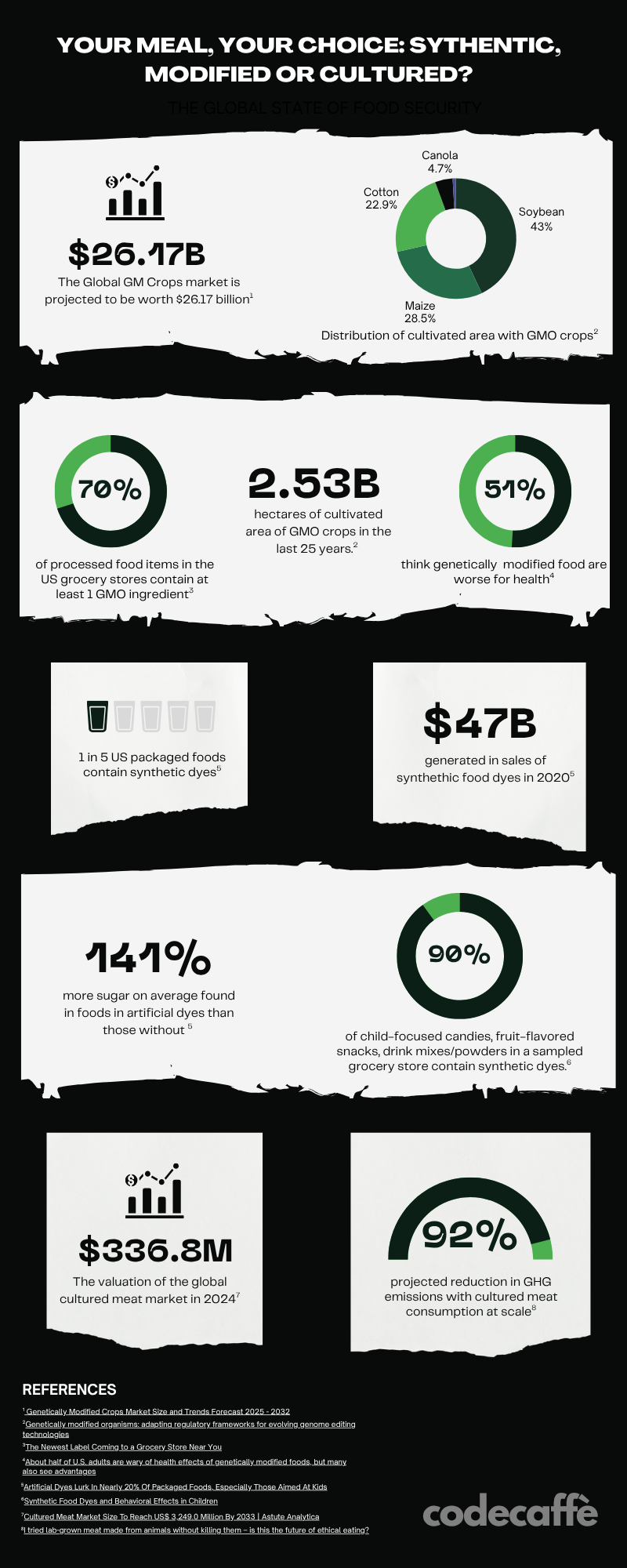
The genetic modification of living organisms has long been a cornerstone of research and development across agricultural, industrial, and biomedical sectors. More than three decades have passed since the first genetically modified (GM) products were introduced, yet regulatory frameworks continue to lag behind the pace of innovation. Over the past 25 years, GM crops have been cultivated on a cumulative total of more than 2.53 billion hectares. The most widely cultivated GM crops include soybean, maize, cotton, and canola, which together occupied 188.6 million hectares. This represents 99% of the global area cultivated with GMOs. Despite variation in national policies, regulatory frameworks can generally be classified into two models: process-oriented and product-oriented. The process-oriented model focuses on the techniques used to develop new plant varieties, while the product-oriented approach evaluates the characteristics of the final modified organism and compares them with conventional equivalents. Both systems typically rely on a case-by-case evaluation to determine safety and compliance.
Cultured meat represents the latest leap in lab-based food engineering. They are produced by cultivating animal cells in bioreactors, eliminating the need to raise or slaughter livestock. Advocates point to their potential benefits: reduced greenhouse gas emissions, lower land and water use, and relief from the ethical dilemmas of factory farming. The controlled environments of production could also minimize pathogens, antibiotic use, and foodborne illnesses. Yet, challenges remain. Current methods are energy-intensive and costly, with scalability and affordability still uncertain. Questions about nutritional equivalence, long-term health impacts, and the additives used in growth media are unresolved. Consumer acceptance also lingers as a barrier, shaped by cultural ideas of what counts as “real” food. Cultured meats, therefore, stand at the intersection of promise and scepticism — a symbol of food innovation that may redefine global diets, but one that must first overcome technical, economic, and cultural hurdles to secure its place on the table.
Ideas as Food, Regulation as Afterthought
The new era of food is being designed in laboratories, marketed as sustainable solutions, and sold on visions of efficiency. From cultured meat to synthetic proteins, these products are racing ahead, but the rules that should govern them are trailing far behind. Corporations frame these innovations as answers to hunger and climate change, yet without robust oversight, they risk becoming another chapter in profit-driven food systems that prioritise scale over safety. Consumers are asked to trust science without guarantees, while regulators scramble to catch up. If ideas are to replace ingredients, society must demand stronger accountability and transparent regulation before the future of food is quietly locked into the hands of a few powerful players.
Espresso Shots
The infographic below provides some summary data on global synthetic, modified and cultured food.
Crème de la Crème
This segment showcases standout companies and startups using biotechnology to address food problems.
Arkeon
Led by Gregor Tegl
Providing a proprietary ingredient production process that is revolutionising food production by turning industrial CO2 into versatile protein ingredients through microbial gas fermentation.
Bactolife
Led by Sebastian Søderberg | Sandra Wingaard Thrane
Advancing the future of gut health with a proprietary food ingredient: natural binding proteins specially formulated to serve a broad range of consumers. These versatile proteins can be integrated into foods, beverages, or supplements, and are designed to selectively bind and block harmful microbial activity while preserving the integrity of the beneficial microbiome.
BioLumen
Led by Paolo Costa | Robert H. Lustig, MD
Pioneering weight loss and gut health with an all-natural structured fiber designed to counteract the harmful effects of Western diets, including obesity, type 2 diabetes, and autoimmune disorders.
Cellva
Led by Sérgio Pinto | Felipe Ricci | Nádia Skorupa Parachin
Delivering food innovation through microencapsulation and biofabrication technologies to develop natural flavor carriers, healthier alternatives to saturated fats, and targeted bioactive compounds.
Clean Crop Technologies
Led by Daniel White | Daniel Cavanaugh | Cody Vild
Providing revolutionary technology that uses electricity to eliminate contaminants and enhance seed and food performance, leading to higher yields, improved food safety, and reduced waste across the supply chain.
Filtricine
Led by John Chant | Grace Xiaolu Yang, Ph.D.
A clinical-stage biotechnology company developing food-based therapies for cancer and metabolic diseases. The company has completed a promising small-scale clinical trial in patients with prostate cancer.
Pytholon
Led by Halim Jubran | Tal Zeltzer
Offering high-quality natural food colors produced through first-in-class baker’s yeast fermentation technology, free from GMOs and allergens, and available in kosher, vegan, and halal-certified options.
Kyomei
Led by Meir W. | Suzanne R.
Leveraging biotechnology to convert waste crop leaves into natural biofactories that produce and extract health-promoting ingredients which are otherwise difficult to source sustainably, naturally, or without relying on animal-derived inputs.
Index BioSystems
Led by Mike Borg | David Singer
Delivering a state-of-the-art predictive food safety platform powered by proprietary BioTags technology, developed from inert baker’s yeast. These uniquely traceable microscopic barcodes enable food safety professionals to simulate contamination events without interrupting production processes.
LiVA Bio
Led by Ifat 🍓 Peled Dinstag | Ifat Hammer
Advancing food shelf-life extension and crop protection with smart bio-preservation and biocontrol solutions that promote the growth of beneficial bacteria, offering an alternative to conventional methods that rely on eliminating all microbes.
MOA Foodtech
Led by Bosco Emparanza García | Jose Maria Elorza Barreda | Susana Sánchez Gómez | Andrey Kessel
Providing groundbreaking technology that harnesses artificial intelligence to convert waste and by-products from the agri-food industry into next-generation protein ingredients
Mimio Health
Led by Christopher Rhodes | Caitlin Beatty | Angela M Zivkovic
A nutraceutical company at the forefront of research and development in fasting-mimicking supplements, designed based on human biology to activate the body’s natural regenerative systems.
Miruku
Led by Amos Palfreyman | Ira Bing | Oded Shoseyov | @Harjinder Singh | Abby Thompson
Combining computational biology with deep-rooted farming traditions to create the next generation of dairy products that minimize the environmental impact of animal agriculture and promote climate sustainability.
NoPalm Ingredients
Led by Lars Langhout | Prof Dr Jeroen Hugenholtz | Jeroen Blansjaar
Leading the transition away from palm-based oils with next-generation technology that uses non-GMO yeasts to ferment agri-food side streams, producing affordable and sustainable alternatives to conventional oils and fats.
Onego Bio
Led by Maija Itkonen | Christopher Landowski | Paavo Salminen | Tom Ferguson
Providing the world’s first non-animal egg protein, Bioalbumen, made through precision fermentation to match the functionality, clean taste, and high-quality protein of traditional eggs. Ideal for large-scale food production, Bioalbumen delivers equal or superior performance across baked goods, snacks, sauces, beverages, meat alternatives, and more, offering a sustainable and scalable alternative without compromise.
Grind Articles
- Global Insights into Cultured Meat: Uncovering Production Processes, Potential Hazards, Regulatory Frameworks, and Key Challenges-A Scoping Review
- The Myth of Cultured Meat: A Review
- Food safety considerations in the advancement of cultured meat: Evaluating novel ingredients
- Scientific, sustainability and regulatory challenges of cultured meat
- Genetically modified organisms: adapting regulatory frameworks for evolving genome editing technologies
The Last Sip
These articles and blogs offer additional context and perspectives on the ideas we explored.
- Red Flags Over Red 40: Heightened Regulatory Scrutiny on Use of Artificial Food Dyes
- Natural Food Color in Focus: Navigating the Changing Regulatory Landscape
- FDA’s ‘plan’ to remove food dyes: Industry ‘understanding’
- Are GMOs bad for your health? Here’s what the science says.
- Could eating like our ancestors make us healthier?
Beyond the Brew
What do our current food choices say about us? They reflect a civilization where capitalism has rebranded nourishment as a commodity and turned eating into another marketplace transaction. Food is no longer only about survival or culture but about patents, shareholder returns, and market dominance. Ten thousand years from now, researchers may not marvel at our ingenuity but instead question how we allowed corporations to patent seeds, monopolize synthetic foods, and dictate what humanity could eat. The legacy of our era may not be the promise of feeding billions, but a cautionary tale of how unchecked profit motives reshaped health, culture, and the human palate itself. Did we feed the world, or did we sell it?
If your work intersects with public health, food justice, policy, or sustainable innovation, let’s connect. I am open to collaboration, editorial partnerships, and consulting engagements focused on equitable systems and critical storytelling.